Anonymization QA
Anonymization is the use case Visual Verifier leads with, because a missed frame is expensive there in a way it is not elsewhere: one unblurred licence plate in a ten-minute clip is a disclosure, no matter how good the other 17,999 frames were.
The failure this catches
Your anonymizer runs. It reports success. A per-frame detector missed the plate on three frames because the vehicle was briefly occluded, or the confidence dipped below threshold, or a worker crashed and a shard was copied through unprocessed.
Nothing downstream notices. The output plays fine. A global metric such as mean pixel difference or SSIM averages three bad frames into fifteen and reports a healthy number.
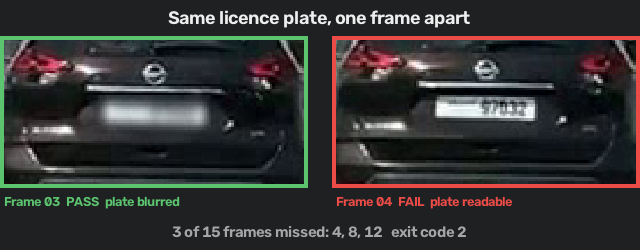
Visual Verifier compares the original with the anonymized candidate frame
by frame, and fails the build naming frames 4, 8, 12.
How to use it
Keep an unprocessed reference of whatever you anonymize. That is the only requirement, and it is usually satisfied already — the anonymizer had an input.
visual-verifier video \
    --reference raw.mp4 \
    --candidate anonymized.mp4 \
    --output artifacts/anonymization-check
Exit code 2 means at least one frame contains no accepted visual change,
which for an anonymization pipeline means at least one frame was left as it
came in.
What a PASS proves, exactly
This is the most important section on this site.
A PASS means:
In every synchronized frame, at least one region changed enough to clear the configured detection thresholds.
A PASS does not mean:
- that a particular face, licence plate, person, or document was found
- that the thing which changed was the thing that needed protecting
- that the transformation is irreversible
- that you are compliant with any regulation
The semantic gap, and how to close it
The default policy is generic_change_every_frame. It verifies that
processing happened, not that the right region was processed.
Consider a frame where the licence plate was accidentally left sharp but the sky changed because of compression. If that sky change clears the thresholds, the frame passes while the plate is still readable.
Supplying reviewed targets closes that gap.
You declare the regions that had to be transformed, the policy
becomes target_coverage_every_frame, and coverage is measured
against those boxes rather than against the frame.
Without targets, treat a PASS as "the pipeline did something
everywhere", which is a real and useful guarantee, and a FAIL as
"the pipeline demonstrably did nothing on these frames", which is a
strong one.
With targets, a PASS means every declared region was covered in every
frame it was declared on. That is the stronger claim, and it is the one
the benchmark measures at 100% recall.
Neither claim is a statement about legibility. Coverage is geometric: it does not prove a plate became unreadable to a human.
Tuning for weak or subtle processing
Light blur on a small region may fall below the defaults. Every threshold is adjustable from the command line:
visual-verifier video \
    --reference raw.mp4 \
    --candidate anonymized.mp4 \
    --min-severity 4.0 \
    --min-box-area 40 \
    --min-changed-ratio 0.02
Lowering thresholds finds weaker processing but admits more noise.
Compression artefacts, sensor noise, and encoder differences all change
pixels. Calibrate against media you understand, and record the values you
chose. They are written into summary.json for exactly that reason.
Privacy of the evidence itself
Verification runs entirely on your machine. Nothing is uploaded, and the package imports no networking library at all. A test enforces this on every commit.
The evidence, however, is derived from your media:
annotated_video.mp4contains the candidate footageindex.htmlembeds thumbnails of the original, unprocessed frames for the before/after comparison
Those thumbnails are the whole point, since they show a reviewer what was exposed, but they mean the report inherits the sensitivity of the input. Store and share evidence directories under the same controls as the source media. The HTML report itself loads nothing from the network, so opening it does not signal to anyone that it exists.
Related
- Limitations — every known failure mode
- Use cases — supported uses and unsupportable claims
- Target annotation — reviewed target schema and coverage behaviour